Wednesday, 29 January 2020

Rationed Health Care.

 
ra·tion
/ˈraSH(ə)n,ˈrāSH(ə)n/
noun
  1. a fixed amount of a commodity officially allowed to each person during a time of shortage, as in wartime.


   As I continue to scan through various medical publications I grow increasingly depressed.  Despite our technological advances stories of patient mismanagement and or neglect seem to be increasing.  I am not talking about medical mismanagement due to lack of diagnostic or management acumen, I am talking of the inability of our system  to adequately deal with the problems due to mismanagement of resources. The present method of dealing with the inadequacy of the system is to ration health care.  Let me state that in another way.  The gross inadequacies in our health care system are dealt with by rationing.  Of course no politician or administrator would call it that.  They prefer to pretend that the obscenely lengthy waiting times are due to shortage of physicians, or nurses, or other health care personnel.  Any such shortages are directly due to their policies.

   Let me give you one example of the outcome of health care rationing, published recently in a medical newspaper.  The writer is a family doctor and she refers to her patient and family by actual name indicating that they were aboard with publishing the story.  The story should be extensively shared with Canadians, most of whom are under the impression that they still have a competent, caring health care system, second to none, whereas in fact we have at best a second rate system heading to become a third rate one.  The patient, something of a minor celebrity, found blood in her urine in October of 2017. She consulted her doctor who despite her concerns could not get an appointment for her to have a cystoscopy to look into her bladder and make a diagnosis.  Incredibly, it took until spring of 2018 for this to be carried out. At that point there was too much blood to make a definitive diagnosis but an infection was thought to be the problem and the patient was put on a  six week course of antibiotics, after which she was to have a follow-up cystoscopy and a CT of the kidney. The antibiotics did not help.  She became weak and anorexic, lost weight and slept most of the day.  The family became so alarmed with the time it was taking to adequately investigate the disease that they paid for a private CT (technically illegal in Canada!) and she was diagnosed with Cancer.  Another wait for a biopsy and yet another to see an oncologist.  The final diagnosis was that she had originally had a bladder cancer, that had spread to her kidneys.  She died on October 1st 2018, quite likely due to a dysfunctional health care system.  
   No government official, even of the lowest rank  would have been treated in this manner.  So much for equality of treatment in a country that claims to provide equality of treatment for all of its citizens, but makes it illegal for people to pay for private health care.  (Unless they are rich enough to go  to the United States).  This is a gross infringement of charter rights.  A blended system works well in Australia and most of the developed countries, improves the accessibility of health care for most of the population and injects additional resources into health care.
   It's time for Canadians to get 'woke' about health care !
  You have your own story of health care failure? Share them. 


Monday, 20 January 2020

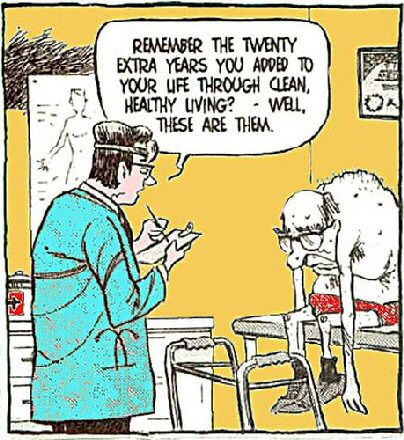
Growing old - not so gracefully!

  Growing old. is easy.  All you have to do is stick around for long enough.

  As the list of my friends and acquaintances thin out, I become increasingly aware of the fact that I am not growing old, I achieved that status years ago, I am growing ancient.   Not bad considering the genetic hand I was dealt.  My siblings too are beating the odds and my wife who is the same age as me continues a full range of household and a not so full range of other activities.  So I have nothing to complain about.   I really never realized I was getting old.  Denial is a potent therapy when used wisely and on occasion it serves quite as well as placebo.   It is not for everyone but it has served me well through real and imaginary crises.
   However, there are certain things that cannot be denied.  That my daughter will soon be getting what we crassly used to call 'the old age pension'.  That I sometimes have to work hard to maintain a look of casual insouciance keeping up with youngsters at the mall.  That schlepping myself out of an armchair I sometimes hear myself making, what I call, 'an old man grunt'. (You know what that is if you are getting your pension). That I'm not quite as smart as I think I used to be!
   Nineteen thirty-five, the year I was born was quite a year.  The world got Monopoly, a game people still play, as well as Shirley Temple dancing with Bo Jangles Robinson and Benny Goodman playing Blue Moon, the top of the hit list. (I still know all the words - it's only the important things I forget!)
   Aubie Blake, the great jazz musician said on reaching ninety, "if I knew I was going to live this long I'd have looked after myself better."  I know what he meant.
   Many years ago while making my hospital rounds I asked an older patient how he was doing.  "Great Doc" he responded.  "I've got the system beat" I asked him what he meant.  " I'm too old to die young," he grinned.
   I let my dentist who has been a friend of mine for twenty years but whose age is nearer my son's age than mine take me out for lunch every now and again.  I figure it's the least he can do in lieu of the vast amount I have invested in him over the years.  He has re-built almost every tooth in my head- painlessly (almost).  As we chatted and I happened to mention a very close friend who bit the dust not too long ago he commented, "Yes, most of your friends must have passed away by now".
   "Yes," I answered appropriately gravely and just so he wouldn't feel too comfortable I added, "even some of my younger ones."
   For years friends - and others, have been cautioning me that one should live every day as though 'tomorrow we die'.  I tell  them not to be so absurd, that thinking like that kills people.  In fact, I live each day as though as though I am going to live forever.  I might just succeed, but if I don't, I'll be the last person to know about it.

Image result for geriatric jokes

Thursday, 2 January 2020

New Vaping Hazard!

OY Vape.

Canada has a disastrous drug problem. ( More than 13,900 opioid deaths occurred between January 2016 and June 2019.) So it shouldn't surprise anyone that the government of Canada and their satraps saw fit to introduce legislation that facilitates converting the least toxic of the street drugs into killer drugs. I am speaking, of course of marijuana, now available for consumption in a myriad of ways few would have thought of until recently. The drug, which is no longer the drug your mother might have smoked has been carefully morphed into a more addicting and toxic form. The variety of presentations, make it more available and desirable to the younger segment of the population.
The latest life-threatening avenue of ingestion has seen the marriage of pot to E-cigarettes. E-cigarettes available since about 2003, were originally touted as a smoking cessation aid, the vaporized substrate was usually water vapour and some nicotine, and were a much less harmful habit than cigarette smoking, an opinion shared by many physicians. Unfortunately they were particularly popular with young people.  
It wasn't long before before the search for sensation led folks to try adding various drugs to the solution.
The Center for Disease Control and prevention in the US, as of December 17, 2019 documented a total of 2506 hospitalized cases of vaping related injuries in the US with 54 deaths confirmed on 27 States. The syndrome has been labeled EVALI (E-Vape Associated Lung Injury). These numbers represent hospitalized patients only, so we can only guess what the grand total might be. All of these patients have a history of using e- cigarettes or other vaping products.
THC, the intoxicating, psychoactive component of marijuana Is present in most of the samples tested by the FDA to date and most patients reported a history of using THC containing products. E cigs work by heating a liquid to vaporization that users inhale into their lungs. The liquid can contain anything including a combination of substances. 80% of the EVALI patients studied reported using THC containing products. 40% reported using both THC and Nicotine containing products. Some people will inject or ingest anything into themselves and have found a new delivery system in vaping. There is still a great deal we don't know about the mechanism of lung injury caused by the current vaping trends and the CDC continues monitoring the cases, testing in various ways for toxic substances and studying lung damage by biopsy and in fatalities by autopsy. They are also maintaining an aggressive educational program, including a web site, which will at least increase awareness among some of the potential victims.
The Center for Disease Control and Prevention recently announced that Vitamen E acetate, an oily chemical added to some THC vaping liquids to thicken them is a substance of concern. The chemical is a synthetic form of vitamin E that has some safe uses but that isn't safe to inhale. it is thick and sticky. It adheres to the lung tissues and interferes with their function and was found in many of the patients with EVALI. Vitamin E acetate has been found in many of the THC vaping cartridges used by patients suffering from lung disease associated with vaping. The role of the legalization of marijuana in the genesis of this new disease certainly needs clarification.


Wednesday, 18 December 2019

Sleepless in London! Anesthesia Department Problems.

One of the worst nightmares of any university department head is to have his department lose its accreditation. After all, the whole justification for the existence of clinical departments is to teach the expertise of which the members are supposed to be the ultimate arbiters and teachers. The humiliation of having a group of carefully selected experts decide that your department doesn't cut the mustard is extreme and the prospect of the department members (and everyone else) working through and addressing the identified shortcomings is painful. I know, I was there once. Although it is rare for provisional accreditation to lead to total withdrawal of accreditation it can do and the re-assessment in two years time had better show that most if not all of the recommendations addressed have been carried out. Otherwise you may be out of business!
So I was more than a little surprised to read in my local newspaper that the accreditation team found that the anesthesia program at the esteemed (they told me so themselves) College of Medicine of the university of Western University not worthy of full registration.
There are numerous reasons why a department may fall short of meeting some of the requirements, many of them not related to the standard of medicine practiced though that of course is a prime concern.
The prestige of the teaching program as well as the performance of its students in national qualifying examinations is another. The excellence of the program as perceived by the participants is crucial. No resident wants to be in a program struggling to maintain its accreditation.
The contribution that the department makes to new scientific knowledge is reflected in numerous ways. Clinical research resulting in publications in prestigious medical and scientific journals, particularly those with an international reputation is the most desirable, but there are other acceptable if less envied ways of enhancing the departments stature. For instance the development of new teaching or evaluation methods, or advancement of practice techniques may make significant contributions and be recognized as such.
Administrative issues can play a major role in determining the success of a department. A well run department optimizes recruitment of quality faculty and residents which further enhances the department and makes it desirable to subsequent excellent candidates.

It will probably be a few weeks before the accreditation report is published. It will make an interesting read to an old has-been department head!

Monday, 9 December 2019

Not the Canada I emigrated to!!

Canada has changed greatly since I emigrated to this country in 1963. I had the good fortune to move here at a time when the pioneer spirit was still alive and well in many Canadians. I moved to Regina, Saskatchewan and my family and I received a warm welcome in that cold climate. The people were tough but very friendly and helpful and there weren't many wimps around. Folks worked hard and a -40F (which is where Fahrenheit and Celsius meet) day was lightly referred to as 'a brisk day'!  People were caring and efficient.
Things have changed greatly!  

A few days ago I went to the Post Office to buy a few stamps. The man behind the counter said, "Sorry, we're out of stamps."
I gazed at him blankly, wondering if I had somehow misheard him or he had misunderstood what I wanted.
"Er, just ordinary local Canadian stamps!" I said.
"Yes, we are out of them!" he smiled blandly.
"I'm not looking for Collectors sets or anything," I reaffirmed," just ordinary stamps".
He smiled some more. "Yes, we are out of them," he repeated. 
"When will you have some in ?" I asked.
"I don't know," he said, shrugging his shoulders. 
I had a letter in my hand I wanted to mail. "How about one local stamp, I have an important letter I'd like to mail now?"
"I can let you have an international stamp," he said, "but it will cost more."
"No thanks," I said, and walked out.
No wonder the country is going down the drain!!

The very same day I needed to get my multiple medication prescriptions refilled.
I phoned the drug store. It was Saturday. One of my prescriptions, a rather vital blood thinner that I have been on for years had run out of repeats. Somehow it had gotten out of sync with my other meds.  
"Sorry, we can't refill this until we get a repeat prescription from the doctor."
"I have run right out of them. I have been getting them from you for years, can you give me a few until I get the doc to phone in a renewal?"
"Sorry, we can't do that, we'll fax the renewal over to the doctor and you can get them as soon as we hear from her."
"Yes, but it is only Saturday, by the time that will be ready it will be Tuesday. I can't wait that long." said I.
"We can get an Emergency Pharmacist Prescription in circumstances like this, but it will cost you $15."
I objected to that on a principle that I don't want to go into here.
"I'll phone the doctor," I said.
I phone the Western University Family Medicine Unit, the teaching clinic where my doctor practices.
"Hello, I urgently need a prescription to be refilled. Can i speak to the Resident on call ?" I know there is a resident on call - I used to run a Department of Family Medicine.
"I'll put you through to the Nurse on call."
"Are you a Nurse?" I ask.
"No, we are a call centre," she answers.
"And where are you located ?" I ask out of morbid curiosity.
"In Northern Ontario." she answers.
"So you can't put my call through to the resident on call ?"
"No, I can only have the nurse on call phone you back."
Okay, I say and give her my phone number.

  A while later the nurse calls me back. Pleasant, polite and helpful, but she has to go through the whole history algorithm which takes a considerable period of time. Although I had been on this medication a very long time, from this same pharmacy and was just requesting pills to tide me over for a few days, their failure to exercise a modicum of commonsense resulted in five people wasting time. To cut to the chase, the nurse informed me she would get through to the resident on call and ask her to call the pharmacy. She would call me back to let me know I could pick up the prescription right away or if there was any obstacle. This she did and I got my prescription.


This is Monday and I stopped by at the local Canada Post Office to pick up the stamps they were out of on Saturday. They were still out of local stamps, but were expecting them in any minute!!   I went to a local chain drug store. They had all the stamps I could use and would give me discount on seniors day, to boot.
I guess free enterprise really does work better.


Wednesday, 27 November 2019

A Geriatric Night in the Emergency Room.

There was hardly anyone in the emergency room that night. We sat in the sparsely occupied emergency department that looked like a bus station at 3 a.m. waiting for the triage nurse to assess my wife. It was six o'clock an I guess everyone was having their supper, including the staff. My wife had fallen down the basement steps and for all they knew could have been hemorrhaging to death. Still, after only half an hour or so sitting dazed in the wheelchair, someone came out to triage her. The girl looked about sixteen and I asked her if she was the triage nurse. No, she said. She was the student triage nurse. She did a good job. She asked the routine questions that I won't bore you with right now and then politely vanished into the night without further comment.
Ah, good, I thought. My wife will soon be seen by the Doctor. We sat and sat. An occasional patient drifted in, otherwise nothing seemed to be happening apart from an occasional patient drifting out. Not like any emergency department I had worked in, and I had worked in quite a few. We hadn't had any supper so I bought an exorbitantly priced bag of potato chips from a vending machine. After that my wife needed a drink (I needed one too, but not of water!). I found a water-vending machine. A small bottle of water cost only $2.95. (A similar sized bottle in Costco is 25c! ) Outrageous - in a hospital yet!!
After only an hour we were called out of the waiting area to have the whole history taken again by the triage nurse as well as a cursory medical examination. This was the real one, not the student! We were ushered back into the waiting room as the triage nurse had identified that my wife was still alive!! The same few patients were still sitting there - none looking as though they needed an emergency room. It was approaching nine pm, my wife and I were getting restless and irritated.   "I'm leaving here and going home if I'm not seen by nine pm." said my poor battered bruised wife who was now exhausted by being in a sitting position for three hours. She had once several years earlier been in the same ER following a severe accident resulting in facial fractures and had insisted on leaving after waiting many hours before being seen, regardless of the consequences. At least on that occasion the ER had been very busy. On this night there was nothing happening apart from an occasional patient drifting in and out.
At about one minute to nine we were again called into the assessment area. This time the young man who assessed her was the medical student. The history and medical examination protocol was again followed. After only a further hour my wife was seen and examined again, this time by the medical resident. After this she (the resident) assured us we would be seen shortly by the Emergency Room Physician. By now my wife was lying on a gurney in a cubicle in the ER, three of the four walls of which were a thin curtain, so that every word of the discussions taking place in the bubble on either side of us seeped through the drapes. So much for the alleged respect for privacy that we hear so much about!
Less than an hour later, the ER Physician appeared in person. He was a pleasant man in his middle forties. The history and physical examination were, of course, repeated once again but this time concise and to the point.
"Looks like she is alright, but we better do a CT scan and a few X rays. Accidents like this kill old people," he said, not unkindly.
So, after shuffling around at home for a day and sitting in a wheelchair in emergency for several hours the patient was placed on a rigid fracture board and neck collar, so as not to transect her spinal cord, while the X rays were performed. In terms of subjective suffering that's when the acute phase
began. The scan and x rays took about an hour but she had to remain immobilized until the results were available and interpreted, which involved another hour. Those two hours were by far the worst part of the whole experience, both because of the acute discomfort of the hard board and immobilization and some temporary but very frightening visual disorientation and vertigo. Eventually the ER physician came back with the good news the CT scan and x rays showed no brain damage or fractures.  
At twelve thirty am, six and a half hours after our arrival, we were on our way home. We knew the game had changed, permanently.

Come back here for further episodes of 'geriatric adventures' in the near future .

Friday, 15 November 2019

"Doctors, get your affairs in order!"

   "Doctors, get your affairs in order!"
       Screamed the op ed piece in the my favourite newspaper, The National Post.   Because I have spent much of my professional life training physicians, I read the article with considerable interest.
   The article was written by an unfortunate journalist whose wife died of a very aggressive malignant melanoma.  Treatment options were very limited and the tumour metastasized relentlessly to her brain.  The author was particularly outraged by the Radiation Specialist who they had never met before.  He came in to share the MRI results with him and his wife.  He gave it to them straight -a little too straight.  Unlike Drs in the past who often avoided the discomfort giving bad news always causes, by just not giving it, physicians understand nowadays that patients want and are entitled to the truth.  There is no way to make bad news sound like good news, but there is such a thing as beating the patient over the head with the truth.  Even the most unpleasant truth can be conveyed with compassion.  "Get your affairs in order is not such a message."  Such a statement is not necessarily arrogance, nor deliberate callousness.  It is often lack of communication skills in a technician who happens to be a health care specialist..   The specialist's opinion was that she had about four to six weeks to live without treatment, maybe three months with radiation to her brain.  After almost sixty years of medical practice, I know there is no way to make bad news sound like good news, but prognosticating in such a definitive fashion is often very inaccurate and decimates the sliver of hope a patient may be hanging on to.  A tiny bit of hope is better than none - and there is always a tiny bit of hope!        

   Patients recognize compassion when it is present and equally recognize its absence.  After delivering the catastrophic news, the physician added, "Get your affairs in order!"  The husband was enraged and insulted.  "Who are doctors to assume such arrogance to themselves?" was his retort.   He went on to say that the only affairs of his wife that were out of order were her medical affairs. 
   He was suffering greatly from a horrible, cruel, acutely painful and unreasonable situation.  Coming to grips with that sort of tragedy is inconceivable. But human beings in suffering, often feel that there must be someone or something responsible for their suffering.  We do look for somewhere to place the blame and often the doctor or nurse is handy. When the health care worker is less than skilled at communicating it compounds the problem.  It often makes them seem indifferent or even callous.  Not all people enjoy the gift of caring communication which in a health care worker is a particularly egregious problem.      The bereaved, in such circumstances cannot conceive of the physician or other health  care worker as being uncomfortable or even grieved and just not knowing how to convey the bad news to the unfortunate victim and/or their family.  Physicians used to be experts at communication with patients.  They spent hours listening, interpreting and explaining to patients the nature of their disorders, their significance, their management and the likely outcome in so far as they anticipated.  In other words Physicians and patients were at one with each other. They were on the same side. The relationship was not adversarial.  I never feared a legal suit because I knew most of my patients were on my side, just as I was on theirs.  There was no 'one complaint per patient', no ten minutes per visit, no 'appointment in six weeks', whether you needed it or not.  An annual 'complete physical examination', was a medium for the physician to become familiar with the patient as an individual and his individual complaints.  It was also an opportunity for the patient to get to know the physician and his/her approach and for them both to get the right match.  It was an indispensable component of thorough medical care, cost a pittance and we have allowed the administridiots to legislate it away. 
   All those things don't seem to matter any longer and we wonder why there is 'no service' anymore.  
   Perhaps it's time for the whole health care system to put its affairs in order!

   Comments welcome.